
Thai Tailoring Culture: From Tradition to Modern Elegance
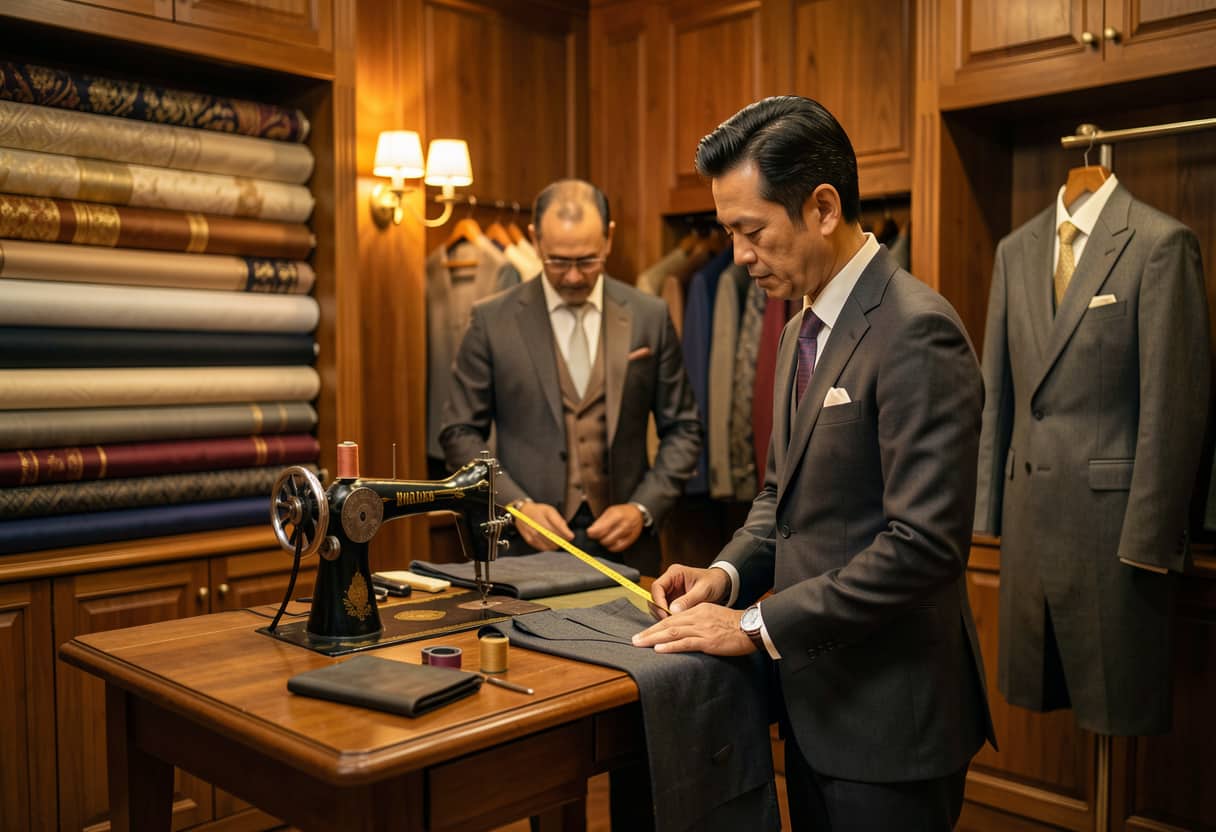
Introduction: The Unlikely Marriage of Thai Craftsmanship and Western Bespoke
When you think of world-class bespoke tailoring, London's Savile Row likely comes to mind first. But walk down Sukhumvit Road in Bangkok today, and you'll find a thriving ecosystem of master tailors who have quietly been perfecting their craft for over half a century. Thai tailoring culture represents one of the world's most fascinating examples of cultural fusion—a story of how traditional Thai craftsmanship adapted, evolved, and ultimately mastered the Western art of bespoke suit making.
The journey from royal court dressmakers to international luxury destination didn't happen overnight. It's a narrative woven through generations of family businesses, shaped by historical forces from American GIs to Japanese tourists, and elevated by an uniquely Thai approach to precision and hospitality. For discerning clients seeking the perfect bespoke suit, understanding this rich heritage offers more than historical interest—it reveals why Bangkok has become synonymous with exceptional tailoring value.
The Historical Tapestry: From Royal Courts to Modern Bangkok
Pre-Modern Foundations: The Era of Court Dressmakers
Before Western suits ever arrived on Thai shores, the Kingdom already boasted sophisticated textile and garment traditions. Royal court dressmakers, known as *chang fae* (ช่างแต่ง), held respected positions within palace hierarchies. These artisans created elaborate traditional garments—notably the *chut thai phra ratcha niyom* (formal Thai dress)—requiring intricate handwork, precise measurements, and an intimate understanding of fabric behavior.
The skills these court artisans developed would prove surprisingly transferable. Thai traditional dress construction demands expertise in working with challenging fabrics like silk, precise fitting to the body, and extensive hand-finishing—all competencies that would later serve Bangkok's tailors well when Western bespoke arrived.
The American GI Era: Seeds of a Tailoring Revolution
The modern Thai tailoring industry traces its origins to the 1960s and the Vietnam War era. As American military personnel flooded into Bangkok for R&R (rest and recreation), they brought with them demand for Western-style clothing—and importantly, Western-style tailoring expectations. The famous tailor shops of what is now Sukhumvit Soi 8 and surrounding areas began as small operations serving this clientele.
Unlike mass-produced garments, these early Bangkok tailors quickly earned reputations for producing quality suits at remarkable speed. American servicemen discovered they could get custom-made garments at fractions of Stateside prices, with turnaround times that seemed miraculous. Word spread through military networks, and the foundation of Bangkok's tailoring reputation was laid.
The Golden Age: 1970s-1990s Expansion
The post-war decades saw Bangkok's tailoring industry expand dramatically. The departure of American forces was more than offset by the arrival of a new clientele: Japanese tourists. Japan's economic boom created legions of business travelers and tourists seeking quality bespoke at prices far below Tokyo rates. Korean and Hong Kong visitors followed, each group bringing their own tailoring expectations and spreading Bangkok's reputation across Asia.
During this period, many of the family businesses that define Thai tailoring today established their foundations. Shops that began as single-tailor operations grew into multi-generation enterprises. The Sukhumvit area, particularly around Nana and Asok BTS stations, evolved into a dense concentration of tailoring excellence—over 200 shops within a few square kilometers at the industry's peak.
Jesse & Son: A Third-Generation Heritage Story
Foundations of Excellence
Among the businesses established during this golden era, Jesse & Son represents the quintessential Thai tailoring success story. Founded over 40 years ago, this family business has spanned three generations—a rarity in an industry where many competitors have come and gone. Their longevity speaks to something deeper than commercial success: a commitment to craft that transcends quarterly profits.
The "Jesse" namesake established the shop's reputation during Bangkok's tailoring boom, building relationships with clients who would become multi-generational customers themselves. Sons (and now grandsons) joined the business not merely as heirs but as apprentices—spending years mastering the fundamentals before assuming leadership roles. This model, echoing traditional Thai craft guild structures, ensured knowledge transfer that formal education simply cannot replicate.
Preserving Craft in a Digital Age
What distinguishes heritage operations like Jesse & Son from newer market entrants is their insistence on maintaining traditional techniques alongside modern efficiency. While many shops have abandoned hand-finishing for faster production, third-generation businesses understand that their competitive advantage lies in craft authenticity.
Hand-sewn buttonholes, canvas construction rather than fused interlinings, and personal pattern drafting rather than computerized standardization—these techniques require more time and skill, but produce garments of demonstrably superior quality. For clients who understand what they're paying for, this heritage approach represents genuine value rather than mere nostalgia.
The Cultural Fusion: Thai Precision Meets British Tradition
The Savile Row Connection
Bangkok's tailoring excellence isn't accidental—it's the result of deliberate knowledge transfer from the world's most respected tailoring tradition. Throughout the 1970s and 1980s, leading Thai tailoring families sent their most promising young craftspeople to London for apprenticeship. They returned with Savile Row techniques adapted to Thai production contexts.
This transfer wasn't simple copying. Thai tailors brought their own strengths to the craft: exceptional eye for detail characteristic of Thai artistic traditions, comfort with handwork from textile heritage, and the Thai cultural value of *kreng jai* (consideration for others)—manifesting in tailors' genuine commitment to client satisfaction.
Adaptation and Innovation
The most successful Thai tailors didn't merely replicate Western methods—they improved upon them. Several innovations emerged from Bangkok's unique position:
Climate-Appropriate Construction: Thai tailors pioneered lightweight construction techniques that maintained structure while accommodating tropical heat. Half-lined and quarter-lined jackets, breathable canvas interlinings, and fabric selection expertise for humid climates became Bangkok specializations.
Speed Without Sacrifice: While traditional Savile Row houses might require 8-12 weeks for a suit, Bangkok tailors developed workflows achieving comparable quality in 2-4 weeks—without resorting to the corners-cutting that characterizes true "fast fashion."
Value Engineering: By combining Western design standards with Thai production efficiencies and lower local costs, Bangkok tailors created a value proposition unmatched elsewhere: genuine bespoke quality at ready-to-wear prices.
Sukhumvit: The Evolution of Bangkok's Tailoring District
Geographic Concentration and Competition
The Sukhumvit Road corridor—stretching from Nana to Phrom Phong BTS stations—represents perhaps the world's densest concentration of bespoke tailoring. This clustering creates intense competition that benefits consumers: shops must maintain high standards or lose business to neighboring competitors.
But Sukhumvit's dominance wasn't inevitable. Early Bangkok tailoring was distributed across multiple districts including Silom, Rajawongse, and Chinatown. Sukhumvit's emergence as the premier destination resulted from several factors:
Infrastructure Development: The BTS Skytrain's Sukhumvit Line provided easy access for international visitors, concentrating tourist-oriented businesses along the route.
Hotel Proximity: The concentration of international hotels in the Sukhumvit area naturally drew tailoring shops seeking walk-in clientele.
Network Effects: As more quality tailors opened in Sukhumvit, the area's reputation grew, drawing more quality tailors—a virtuous cycle of concentration.
District Character and Specialization
Within Sukhumvit, subtle specializations have emerged:
Nana Area (Sukhumvit Soi 3-11): Higher concentration of shops serving Middle Eastern and Indian clientele, with expertise in specific regional style preferences.
Asoke Intersection (Sukhumvit Soi 14-23): Mix of tourist-oriented and serious bespoke operations, including several multi-generation family businesses.
Phrom Phong (Sukhumvit Soi 30+): Increasingly upscale positioning, with shops targeting Japanese and Korean luxury consumers.
Modern Thai Bespoke: Heritage Meets Innovation
Technology Integration
Today's leading Thai tailors haven't rejected technology—they've integrated it thoughtfully. Computer-aided design (CAD) systems assist with pattern storage and modification. Digital measuring tools provide precise baseline data. Online consultation platforms enable remote clients to begin the bespoke process before arriving in Bangkok.
But technology serves craft rather than replacing it. The critical elements—personal measurement interpretation, fabric hand-feel assessment, fitting adjustments based on client movement patterns—remain irreducibly human skills.
Sustainable Practices
An emerging differentiator among heritage Thai tailors is environmental consciousness. Traditional bespoke was inherently sustainable—garments made to last decades, repaired rather than replaced, constructed from natural materials. Modern operations like Jesse & Son have formalized these practices:
-
Fabric sourcing: Direct relationships with Italian and English mills ensure quality and traceability
-
Waste reduction: Pattern efficiency maximization and scrap recycling
-
Repair services: Alteration and repair departments extending garment lifespans
-
Local production: Bangkok-based manufacturing reducing carbon footprint versus European alternatives
The Client Experience: What to Expect
The Consultation Process
Quality Thai bespoke begins with comprehensive consultation. Expect to spend 45-60 minutes discussing:
Use Case Analysis: The tailor should ask detailed questions about where and how you'll wear the garment—office environments, climate conditions, frequency of wear.
Style Preferences: Review of lapel styles, pocket configurations, button stances, and silhouette preferences. Experienced tailors will guide based on your body type and intended use.
Fabric Selection: Guidance through hundreds of options, with explanations of weight, drape, durability, and seasonal appropriateness.
Fittings and Refinement
The bespoke process typically involves 2-3 fittings:
First Fitting (Basted): Initial construction using temporary stitching to assess basic fit and proportion.
Second Fitting: Refined construction with adjustments to sleeve length, shoulder fit, waist suppression, and overall balance.
Final Fitting: Minor tweaks and finish assessment before completion.
Timeline and Investment
For quality Thai bespoke, realistic expectations include:
-
Timeline: 2-4 weeks from first measurement to completion
-
Investment: 15,000-50,000 THB ($400-$1,400 USD) depending on fabric and construction complexity
-
Longevity: Properly cared for bespoke suits should last 10-15+ years
Frequently Asked Questions About Thai Tailoring
Why is Bangkok considered a world-class tailoring destination?
Bangkok combines several unique advantages: generations of accumulated expertise, intense competition driving quality standards, favorable cost structures enabling exceptional value, and a culture of genuine hospitality that prioritizes client satisfaction. The result is bespoke quality rivaling London or Milan at substantially lower investment.
How do I choose a reputable tailor in Bangkok?
Look for multi-generation family businesses with physical showrooms (not just hotel-based operations), willingness to explain construction details, transparent pricing, and realistic timelines (avoiding same-day or 24-hour promises for quality bespoke). Online reviews help, but personal referrals from satisfied clients remain the gold standard.
What's the difference between bespoke, made-to-measure, and custom?
Bespoke: Individual pattern created from scratch for your body, multiple fittings, hand construction elements. The highest tier of tailoring.
Made-to-Measure: Modified standard pattern based on your measurements, limited fitting, primarily machine construction. Mid-tier option.
Custom: Often misused marketing term that may indicate anything from basic alterations to true bespoke. Require clarification of actual construction methods.
Quality Thai operations like Jesse & Son specialize in genuine bespoke.
Can I get quality bespoke if I'm only visiting Bangkok briefly?
Yes, with planning. First consultation and measurement can occur early in your trip, with fittings scheduled before departure. Alternatively, many tailors store your pattern for future orders, enabling remote re-ordering after initial in-person fitting.
How do Thai tailors compare to those in Hong Kong or Singapore?
Bangkok, Hong Kong, and Singapore all offer quality bespoke, but with different characteristics:
-
Bangkok: Best value proposition, widest range of options from budget to luxury, strong heritage operations
 +66814437747
 @jesseandson